
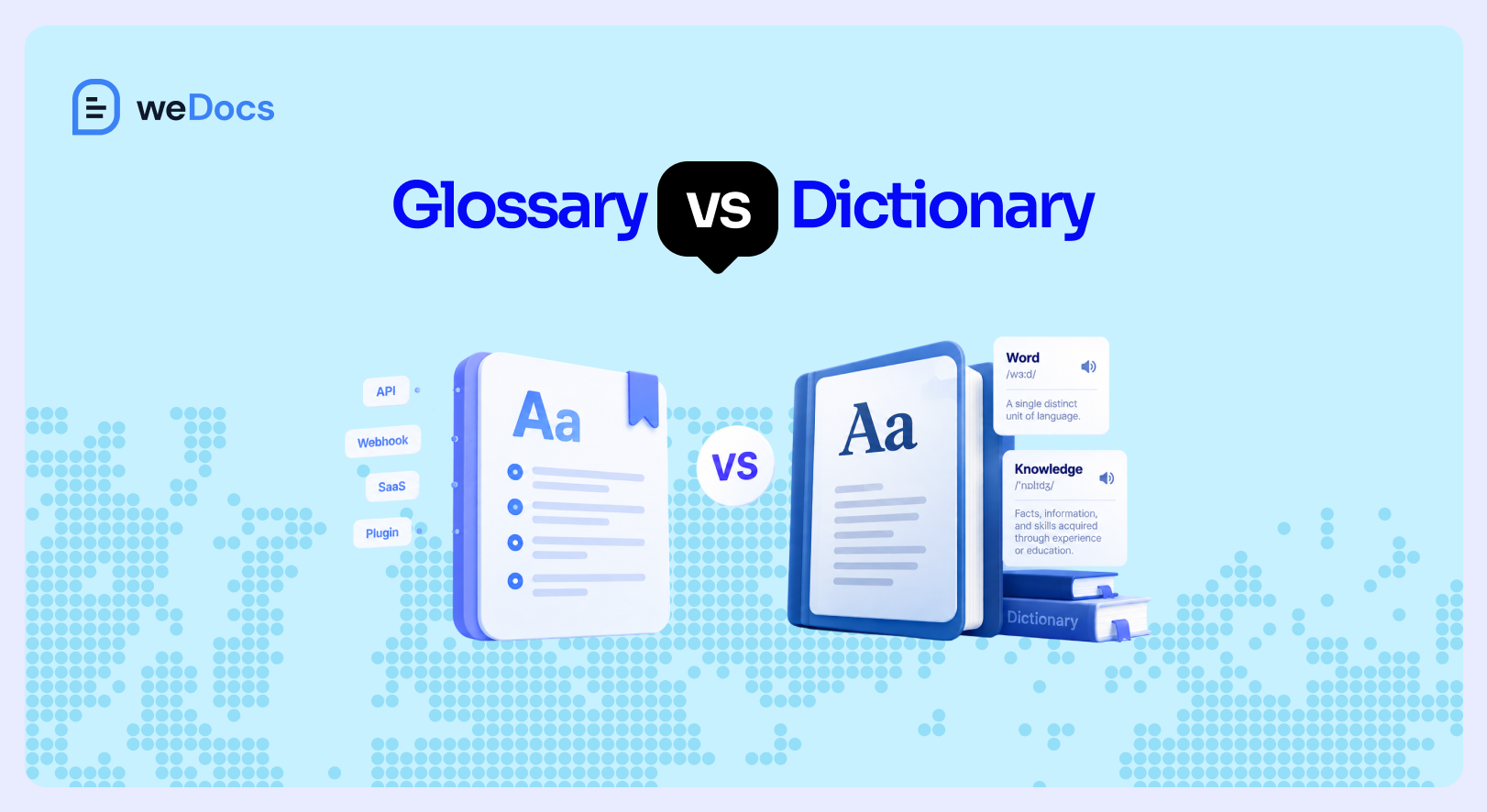
People use the two words as if they mean the same thing. They do not, and the difference decides which one you should be writing.
A dictionary explains what a word means. A glossary explains what a word means here, in this document, this product, or this field. One is a reference for a language. The other is a reference for a context.
This guide covers what separates them, when each is the right tool, and why almost every technical document needs a glossary rather than a dictionary.
TLDR
- A dictionary defines words across a whole language, with every meaning a word can carry.
- A glossary defines specialised terms within one document, product, or field, using only the meaning that applies there.
- Dictionaries are compiled by lexicographers over years. Glossaries are written by whoever owns the document, usually in an afternoon.
- A dictionary entry can run to several numbered senses. A glossary entry is one or two sentences.
- If you are writing documentation, you need a glossary. A dictionary is something you link to, not something you build.
Glossary vs Dictionary, the Short Answer
A glossary is a short list of specialised terms defined for one specific context. A dictionary is a comprehensive record of the words in a language, defined for every context.
Scope is the difference underneath all the others. A dictionary tries to be complete about a language. A glossary tries to be useful about a document.
| Glossary | Dictionary | |
|---|---|---|
| Covers | One document, product, or field | A whole language |
| Answers | What does this word mean here? | What does this word mean? |
| Entry length | One or two sentences | Multiple senses, often with examples |
| Includes | Only terms readers might not know | Common and rare words alike |
| Written by | The document’s author or team | Lexicographers, over years |
| Typically holds | 20 to a few hundred terms | Tens of thousands to a million |
| Usually contains | Definitions only | Pronunciation, etymology, word class, usage |
| Lives | Inside or beside the document it serves | As a standalone reference |
What a Glossary Is
A glossary is an alphabetical list of specialised terms with short definitions, scoped to one document, product, subject, or organisation.
It exists because the writer already knows the vocabulary and the reader might not. When a term appears that a newcomer would stumble over, the glossary catches them without interrupting the main text.
Crucially, a glossary defines a term the way your context uses it. If your product uses “workspace” to mean something specific, that is what goes in the entry. You are not recording every possible meaning, only the one that applies.
Writing definitions down like this turns something your team knows into something anyone can use, which is what makes a glossary a piece of explicit knowledge rather than shared assumption.
What a Dictionary Is
A dictionary is a comprehensive reference recording the words of a language, with their meanings, pronunciations, origins, and grammatical behaviour.
Where a glossary is selective, a dictionary aims at completeness. It includes words you already know, words nobody uses, and words that appear in one field only, because its job is to record the language rather than serve a document.
It also records multiple meanings. A dictionary entry for “bank” covers the financial institution, the side of a river, and the act of tilting an aircraft, because all three are real. A glossary would list only the one its document means.
The Five Real Differences
Everything in the table above comes down to these five.
1. Scope
A dictionary covers a language. A glossary covers a document. That is why a dictionary runs to hundreds of thousands of entries and a glossary rarely passes a few hundred.
2. Selection
A dictionary includes a word because it exists. A glossary includes a term because a reader might not know it. Padding a glossary with obvious words makes people stop checking it.
3. Single meaning versus every meaning
This is the most practical difference. A dictionary lists every sense a word carries. A glossary lists the one your document uses, which is precisely what makes it useful mid-sentence.
4. Depth
Dictionary entries carry pronunciation, word class, etymology, and usage notes. A glossary entry carries a definition and stops. The reader is mid-paragraph and wants to get back to reading, which is the same brevity discipline described in our guide to concise documentation.
5. Authorship
Dictionaries are compiled by teams of lexicographers tracking real usage over years. A glossary is written by whoever owns the document, often in a single sitting, and updated whenever the product changes.
Which One Do You Need?
If you are asking this question about your own writing, the answer is almost always a glossary.
| If you want to | You need |
|---|---|
| Explain terms used in your product or docs | A glossary |
| Define acronyms your team invented | A glossary |
| Record how your organisation uses a common word | A glossary |
| Help a reader through one book or manual | A glossary |
| Look up an unfamiliar English word | A dictionary |
| Check spelling, pronunciation, or word origin | A dictionary |
Nobody builds a dictionary for their product. You link to one if a reader needs general language help, and you write a glossary for everything specific to you. Our documentation best practices treat a glossary of key terms as part of a working style guide for exactly this reason.
Where the Confusion Comes From
Three things blur the line in practice.
Some glossaries got big. Industry glossaries can run to thousands of entries and start to feel like dictionaries. They are still glossaries, because they cover one field rather than a language.
Some dictionaries got narrow. A medical dictionary or a legal dictionary sits close to a glossary in scope. The distinction holds because they still aim at completeness within their subject and carry dictionary-style depth.
Software calls both things the same thing. Tools label features “dictionary” when they mean a term list, and “glossary” when they mean a spellcheck wordlist. The names drifted, which is why understanding the underlying difference matters more than the label on a menu.
Frequently Asked Questions
1. Can a document have both a glossary and a dictionary?
A glossary, yes. A dictionary, no, and you would not want one. What documents pair a glossary with is an index, which tells readers where a topic is discussed rather than what a term means.
2. What is the difference between a glossary and a lexicon?
Very little in everyday use. Lexicon tends to mean the full vocabulary of a language or field, while glossary usually means a shorter list attached to a document. The two overlap enough that most readers treat them as interchangeable.
3. Is a glossary the same as a terminology list?
Close, but a terminology list often omits definitions entirely and simply records which term is approved. Translation teams use them to lock down wording across languages. A glossary always defines.
4. How long should a glossary entry be?
One or two sentences. If it runs longer, you are writing an article, and the glossary should link to that article rather than contain it. Writing definitions that read like dictionary entries is one of the common documentation mistakes teams make.
5. Does a glossary go at the front or the back?
In print, the back, before the index. In digital documentation it works better as its own page in the navigation, with terms explained where they appear so readers never leave the page they are on.
6. Who decides what a term means in a glossary?
Your organisation does, and that is the point. A dictionary records how a language uses a word. A glossary records how you use it, which is why two companies can define the same term differently and both be right.
Write the Glossary, Link the Dictionary
The distinction is simpler than the debate suggests. A dictionary belongs to a language and somebody else already built it. A glossary belongs to your document and only you can write it.
So if you are deciding between them, you are not really deciding. Write down the terms your readers will not know, define each in a sentence using your meaning, and put the list somewhere findable. That is a glossary, and it is the only one of the two you will ever need to make.
For where that fits alongside everything else your readers need, our guide on the types of product documentation covers the full set.
Subscribe to
weDocs blog
We send weekly newsletters,
no spam for sure!